
Why Prompting Isn’t Enough — and Why AI Reliability Now Belongs to Systems Architects
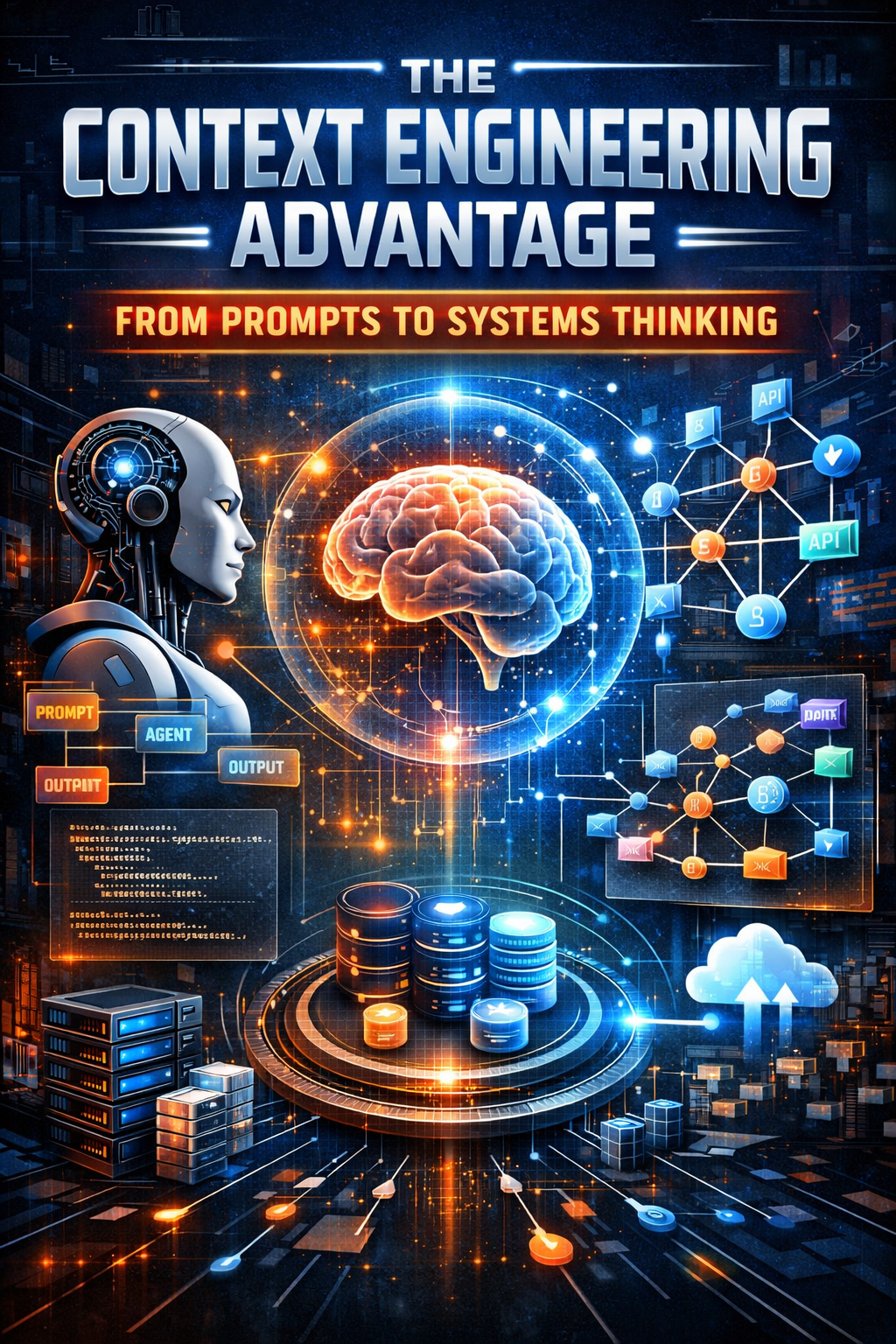
In 2023, we optimized prompts. In 2024, we optimized chains. In 2025, we optimized agents. In 2026, the real competitive advantage is something else entirely: Context Engineering.
To be precise: prompting is not “dead”, but it is no longer the bottleneck. What separates strong teams now is how intentionally they design what the model sees, when it sees it, and what it is allowed to do.
The teams winning with AI today are not the ones writing clever prompts. They are the ones designing how information flows into, through, and around models.
AI performance is no longer limited by model capability; it’s limited by context architecture.
To be precise, model capability still matters. Frontier models significantly improve reasoning depth and robustness. But in many real-world systems, performance is constrained more by context design than raw model intelligence. In production environments, AI incidents are rarely pure “model failures.” They are retrieval failures, state failures, or constraint failures.
This post dives deep into:
- Why prompt engineering is no longer enough.
- What Context Engineering actually means.
- Architectural patterns that work in production (MACH, Micro Frontends).
- Failure modes most teams miss.
- A full example with code (Python + RAG + structured memory).
- A systems blueprint you can apply immediately.
The Shift: From Prompts → Agents → Context Systems
Most teams still think in this linear progression:
- Write a prompt.
- Add tools.
- Add agents.
- Profit.
That’s incomplete. As an engineering leader who has driven global digital transformations, I’ve seen that real-world performance is determined by a specific equation:
Model Intelligence × Context Quality × Retrieval Precision × Memory Structure
Think of this as a systems mental model, not a literal mathematical formula. Each factor amplifies or degrades the others. A highly capable model with poor retrieval still fails. A well-structured context pipeline can dramatically increase reliability even when using smaller or cost-optimized models.
If context is wrong, incomplete, or noisy, even frontier models fail. If context is structured, constrained, and intentional, even smaller models perform reliably.
The shift is from: “How do I phrase the question?” to: “What information architecture guarantees the model cannot fail?”
(And in production: you never truly guarantee. You constrain, validate, and observe.)
What Is Context Engineering?
Context Engineering is the deliberate design of:
- What information the model sees.
- Structure: Using JSON schemas and Pydantic models.
- Order: Prioritizing information based on task relevance.
- Constraints: Implementing guardrails and secure coding practices.
- Operational metrics like DORA do not validate individual model outputs directly. Instead, they measure the system’s delivery performance and resilience. In mature AI systems, context changes are treated like code changes, complete with regression testing, evaluation harnesses, and deployment monitoring.
It combines Retrieval-Augmented Generation (RAG), memory design, and tool orchestration. It is systems architecture for LLM cognition.
Why Prompt Engineering Is Insufficient
Prompt engineering assumes the model understands your domain implicitly. In complex environments — like the 15+ international markets I managed for Polestar — instructions are never enough.
Reality of unstructured context:
- Models hallucinate when context is incomplete (they “fill gaps”).
- They drift when context windows are overloaded (they lose the thread and misprioritize).
- They degrade when token windows fill with noise (important constraints get buried).
Example failure:
You build a support bot with 40 PDF documents and raw history. Without structured context, you get partial answers and policy hallucinations because the information was not architected.
The Four Layers of Context Architecture
To build scalable platforms, we must address four distinct layers:
- Instruction Context: System prompts, role definitions, and output constraints.
- Retrieval Context: Domain knowledge via RAG chunks and knowledge graphs.
- Memory Context: Task state, user preferences, and structured history.
- Control Context: JSON schemas, tool definitions, and validation loops.
Most AI failures happen because one of these layers is missing.
Example: Why Context Design Beats Bigger Models
System A: Frontier model + Basic RAG + No schema.
System B: Smaller model + Structured RAG + Typed memory + JSON validation.
System B often wins. Why? Because the model operates inside a designed cognitive container, reducing the need for probabilistic guessing.
This does not mean larger models are unnecessary. Larger models expand capability. Context engineering improves controllability. In enterprise environments, controllability often determines whether a system can be safely deployed at scale.
Real Production Pattern: Structured RAG + Typed Memory
Use Case: AI Feature Spec Generator for Engineering Teams.
Step 1: Define Strict Output Schema
Using Python and Pydantic forces the model into a deterministic structure.
from pydantic import BaseModel
from typing import List

class FeatureSpec(BaseModel):
    title: str
    summary: str
    technical_requirements: List[str]
    api_dependencies: List[str]
    risks: List[str]
    rollout_plan: List[str]
Step 2: Structured Retrieval Instead of Raw Text
Retrieve typed objects with metadata rather than random paragraphs.
class ApiDoc(BaseModel):
    name: str
    endpoint: str
    method: str
    constraints: List[str]
Step 3: Controlled Prompt Template
SYSTEM_PROMPT = """
You are a senior software architect.
Use only the provided API documentation.
Do not invent endpoints.
Output strictly in valid JSON.
"""
Step 4: Validation Loop
If validation fails, re-prompt with correction instructions. This is essential for maintaining quality and resilience.
from jsonschema import validate

def validate_output(output_json, schema):
    try:
        validate(instance=output_json, schema=schema)
        return True
    except Exception:
        return False
Memory Design: The Silent Multiplier
Most teams store entire raw transcripts, which creates noise. A better pattern is Task-Based Memory, where you store structured task states.
class TaskState(BaseModel):
    feature_id: str
    current_step: str
    approved: bool
    open_questions: List[str]
This makes AI workflows traceable, debuggable, and aligned with Agile practices.
Failure Modes in 2026 AI Systems
- Context Overflow: Excessive memory degrades reasoning. Solution: Summarize and keep structured state.
- Retrieval Noise: Irrelevant RAG chunks. Solution: Use hybrid retrieval (semantic + metadata).
- Tool Drift: Agents using the wrong tools. Solution: Restrict tool access by state.
- Latency Explosion: Multi-agent loops. Solution: Batch reasoning and use smaller validation models.
Advanced Pattern: Two-Model Architecture
Instead of one large model, use two:
- Model A (Creative): A frontier model for reasoning.
- Model B (Validator): A smaller, faster model (or rules-based validator) for deterministic checks.
This improves reliability while significantly reducing token budgets and costs.
The New Skill Stack for 2026
To lead in this era, engineers must evolve beyond code into AIAO (AI Agent Optimization). Your stack now includes:
- Vector search infrastructure (e.g., Postgres with a vector extension, MongoDB Atlas Vector Search)
- Understanding evaluation metrics such as grounding rate, retrieval recall, hallucination rate, and tool success rate.
- Because in 2026, serious AI systems are measured — not just built.
- Knowledge graph modeling.
- Schema enforcement and state machine orchestration.
- Cloud-native AI services (Azure, AWS).
A Practical Blueprint You Can Apply Tomorrow
- Define output schema first.
- Design structured retrieval.
- Separate memory from transcript.
- Enforce validation loops.
- Restrict tools by role.
- Optimize token usage.
- Add a second model for verification.
Why Vector Search (Flat RAG) Is Not Enough
Traditional RAG relies on vector similarity, which finds pieces of text that look similar but don’t necessarily relate logically.
The Problem: If you ask an AI about a specific checkout bug, a vector search might pull up a “Checkout” document and a “Bug Report” document, but it might miss the crucial Service Dependency that connects them.
The Consequence: This leads to “Hallucinated Connections” where the model guesses how components interact because the underlying architecture wasn’t provided.
The Power of Graph-Based Retrieval
Graph-Based Context utilizes a Knowledge Graph (KG) to provide the model with a map of relationships. Instead of just “chunks” of text, the model receives “nodes” and “edges.”
Example: Feature → API → Service → Dependency → Owner
In a production environment, a Graph-Based context system works as follows:
- Traversing Relationships: If the task is to “Update the Login API,” the system doesn’t just retrieve the API spec. It traverses the graph to find the PostgreSQL database it queries, the OAuth2/SSO security protocols it follows, and the Sentry observability standards required for the rollout.
- Structural Integrity: By injecting these explicit relationships, you provide the model with a “Source of Truth” for how the system is built, eliminating the need for the model to “reason” about the infrastructure from scratch.
Implementation Pattern: GraphRAG
To implement this in a 2026 AI stack, we combine Semantic Search with Graph Traversal:
- Step 1: Entity Extraction: Use an LLM to extract entities (Services, Libraries, Teams) and their relationships from your technical documentation (RFCs, Jira, Confluence).
- Step 2: Graph Construction: Store these in a graph-compatible structure (like Neo4j or as a relational mapping in PostgreSQL).
- Step 3: Context Injection: When a query is made, the system performs a “sub-graph extraction.” It pulls the target node and all nodes within 2 “hops.”
The Result: The model receives a prompt that says: “You are modifying Service X. Note that Service X depends on Service Y, which is currently undergoing a MACH architecture migration. Do not use deprecated endpoints.”
Graph-based retrieval is not required for every system. It introduces complexity and operational overhead. It becomes particularly powerful in domains where relationships matter more than semantic similarity: distributed systems, compliance-heavy environments, multi-market architectures, and dependency-driven platforms.
This nuance prevents overgeneralization and strengthens credibility.
The Impact on Reliability: This is the “Next Frontier” because it moves AI from being a conversational partner to a Context-Aware Architect. It ensures that the 15+ international markets or 8 global rollouts you are managing remain consistent because the AI is bound by the actual relational constraints of your ecosystem.
Technical Implementation Guide: GraphRAG for Enterprise Ecosystems
To move beyond flat vector search and eliminate hallucinated dependencies, we can implement a Graph-Based Context system. This approach is particularly effective for managing complex, multi-market architectures like those I oversaw some client projects.
- The Architectural Blueprint
- Instead of a single database, we use a hybrid approach that combines the semantic power of Vector DBs with the relational logic of Knowledge Graphs.
Nodes: Represent entities such as Services, APIs, Markets (e.g., 15+ international deployments), and Compliance Standards (e.g., WCAG, GDPR).
Edges: Represent relationships like DEPENDS_ON, DEPLOYS_TO, or COMPLIANT_WITH.
- Step-by-Step Implementation (Node.js & PostgreSQL)
Phase A: Schema Definition
We utilize PostgreSQL for its robust relational capabilities and vector extensions.
-- Core Table for Graph Nodes
CREATE TABLE graph_nodes (
    id UUID PRIMARY KEY,
    name TEXT NOT NULL,
    type TEXT NOT NULL, -- 'Service', 'API', 'Market'
    metadata JSONB,
    embedding VECTOR(1536) -- For hybrid semantic search
);
-- (Using the pgvector extension for hybrid semantic + relational retrieval.)

-- Relationship Table for Graph Edges
CREATE TABLE graph_edges (
    source_id UUID REFERENCES graph_nodes(id),
    target_id UUID REFERENCES graph_nodes(id),
    relationship_type TEXT NOT NULL -- 'DEPENDS_ON', 'OWNS'
);
Phase B: Relationship-Aware Retrieval (The “Two-Hop” Query)
When an engineer asks about a feature, we don’t just find the text; we find the Contextual Neighborhood.
// Node.js implementation to fetch a Sub-Graph for Context
async function getContextualSubGraph(entityName) {
  // 1. Find the target node via semantic or exact match
  const rootNode = await db.query('SELECT id FROM graph_nodes WHERE name = $1', [entityName]);

  // 2. Perform a Graph Traversal (Recursive CTE) to find dependencies
  const query = `
    WITH RECURSIVE SubGraph AS (
      SELECT source_id, target_id, 1 as depth
      FROM graph_edges WHERE source_id = $1
      UNION
      SELECT e.source_id, e.target_id, s.depth + 1
      FROM graph_edges e
      INNER JOIN SubGraph s ON s.target_id = e.source_id
      WHERE s.depth < 2 -- Limit to 2 hops for performance and token budget
    )
    SELECT * FROM SubGraph;
  `;

  return await db.query(query, [rootNode.id]);
- Injecting Graph Context into the LLM
- By transforming these relationships into a structured text block, we provide the model with a “Deterministic Boundary”.
Engineered Prompt Fragment:
“The following architectural constraints are retrieved from the Knowledge Graph:
Target: Service A
Immediate Dependency: API B (currently migrating to MACH Architecture)
Downstream Impact: Market Deployment C (15+ markets affected)
Compliance Requirement: Must maintain WCAG Accessibility”
- The Result: Strategic Reliability
- This implementation mirrors the Capability Lead approach of standardizing practices via RFCs and architectural audits. It ensures that the AI’s “thinking environment” is grounded in the actual technical debt and platform standards of the organization.
The Bigger Perspective:
Better models don’t solve reliability; better context does. More accurately: better models improve capability. Better context improves reliability. Capability determines what the system can do. Context architecture determines whether it can do it safely and consistently.
As models grow, they amplify noise. The competitive advantage is no longer prompt cleverness — it’s cognitive infrastructure design.
The AI era is not about writing better prompts. It is about designing better thinking environments.
Perspective: Treat context like production infrastructure
The most useful mental shift is this: context is not “prompt content”. It’s runtime infrastructure. It deserves the same rigor as APIs and databases:
- SLIs/SLOs for retrieval quality (hit-rate, freshness, grounding rate)
- Change control for knowledge sources (doc versioning, release notes)
- Testing for context regressions (golden sets, eval harnesses)
- Incident response when hallucinations become user-visible failures
In practical terms, this means logging:
- What documents were retrieved
- Why they were retrieved
- What tokens were injected
- What constraints were active
- What tool calls were executed
Without observability into context, debugging AI systems becomes guesswork.
When you do this, you stop debating model choice every week, because your reliability comes from the system, not from the model.
Summary: the minimum viable Context Engineering stack
- A schema for outputs (and hard validation)
- Hybrid retrieval (semantic + metadata + recency)
- Typed task memory (state, not transcripts)
- Tool permissions by role/state
- A verifier (small model or rules) before production actions
- Observability on context: what was retrieved, why, and what was used
Closing thought
Better models will keep arriving. But the teams that win are the ones who build AI systems that can survive: stale docs, partial data, noisy history, and evolving architectures.
The most successful AI teams in 2026 are not model tinkerers. They are cognitive infrastructure engineers. They design the thinking environment, not just the question.
That’s not prompt engineering. That’s systems engineering.