
Imagine your cloud infrastructure as a high-performance sports car. It’s powerful, fast, and can take your business places you’ve never been before. Without a skilled co-pilot, you might face problems. They help monitor fuel use, route efficiency, and performance.
Without their help, one could be stranded and facing a large bill. That’s precisely where FinOps comes in as your financial co-pilot for the cloud journey.
Most organisations are driving their cloud vehicles blindfolded. They’re accelerating digital transformation, but their cloud costs are spiralling out of control. Using a cloud cost optimisation strategy with FinOps can help reduce your cloud spending.
This guide will serve as your roadmap to implementing FinOps successfully. This can transform your cloud from a cost centre into a strategic asset that drives genuine business value.
What is FinOps and How Does It Solve the Problem of Cloud Cost?
FinOps is short for Financial Operations. It’s a cultural practice that brings financial accountability to the variable spend model of cloud computing. Think of it as your financial GPS for navigating the complex terrain of cloud economics. According to the FinOps Foundation, you could save 20–30% in the first year.
Traditional IT cost management operates like an annual budget meeting. There, you guess your needs twelve months in advance. FinOps functions more like a real-time fuel efficiency monitor. It provides continuous visibility, immediate feedback, and actionable insights that help you make informed decisions about your cloud spend.
FinOps vs. Traditional Cloud Cost Management
Traditional Approach:
- Reactive: You discover overspending after the damage is done
- Siloed: Finance, IT, and business teams work in isolation
- Monthly: Cost reviews happen once per month (if at all)
- Blame-focused: When costs spike, finger-pointing begins
FinOps Approach:
- Proactive: Real-time monitoring prevents surprises
- Collaborative: Cross-functional teams share accountability
- Continuous: Daily visibility and weekly optimisation cycles
- Solution-focused: Teams work together to solve cost challenges
Traditional cloud cost management is like checking your bank balance once a month and hoping for the best. FinOps is like having a financial advisor sitting beside you, guiding every spending decision.
How to Implement FinOps?
Implementing FinOps isn’t about installing software and hoping for magic. It’s about creating a culture where every team member is aware of costs. This should happen while keeping the agility and innovation that attracted you to the cloud.
Last month, I witnessed a CTO nearly choke on his morning coffee when he opened his AWS bill. £47,000 for what should have been a £15,000 month. According to Flexera’s 2024 State of the Cloud Report, organisations waste an average of 32% of their cloud spend. That’s nearly one-third of your budget disappearing into the digital ether.
The FinOps implementation journey follows three distinct phases, each building upon the previous one. Think of it as learning to drive that high-performance car we mentioned earlier. You start with basic controls and progress to advanced techniques. And eventually master the art of performance driving.
What Are the Key Stages of FinOps Implementation?
Phase 1: Inform — Gaining Cloud Spend Visibility
Before you can optimise anything, you need to see clearly. This phase is about installing the dashboard, mirrors, and gauges that will guide your journey.
Essential Actions:
- Centralise billing data across all cloud providers and accounts
- Implement comprehensive resource tagging (minimum: Environment, Owner, Project, Cost Centre)
- Create unified cost dashboards that everyone can understand
- Establish baseline metrics for current spending patterns
- Set up automated cost alerts for budget thresholds
You need to understand where every pound is going before you can make informed decisions about where it should go.
Phase 2: Optimise — Making Smarter Decisions
Now that you can see clearly, it’s time to start driving more efficiently. This phase focuses on right-sizing resources and eliminating waste. It’s about making your cloud infrastructure work smarter, not harder.
Key Optimisation Strategies:
- Right-size instances based on actual usage patterns
- Implement reserved instances for predictable workloads
- Leverage spot instances for fault-tolerant applications
- Identify and eliminate cloud waste (unused resources, over-provisioned instances)
- Optimise storage classes based on access patterns
- Schedule non-production resources to run only when needed
Remember, cloud cost optimisation isn’t about cutting costs at any price. It’s about getting maximum value from every pound spent.
Phase 3: Operate — Sustaining Cloud Cost Optimisation
The final phase transforms FinOps from a project into a practice. This is where you embed cost consciousness into your organisation’s DNA. This ensures that efficient cloud usage becomes as natural as checking your mirrors before changing lanes.
Operational Excellence Elements:
- Regular cost review meetings (weekly for high-growth teams)
- Continuous training programmes for development and operations teams
- Cost allocation frameworks that fairly distribute expenses
- Performance metrics that balance cost with business value
- Automated governance policies that prevent costly mistakes
Is your cloud cost spiralling out of control? Don’t let cloud overspending eat into your profits. Emvigo can help you implement the right cloud strategy and regain control. Ready to turn cloud costs into a predictable asset? Reserve a free cost audit here!
What Are the FinOps Principles?
The FinOps Foundation has established six core principles that guide successful cloud cost optimisation. These are practical guidelines that shape how high-performing teams approach cloud financial management.
FinOps Principles — Description & Practical Application Table
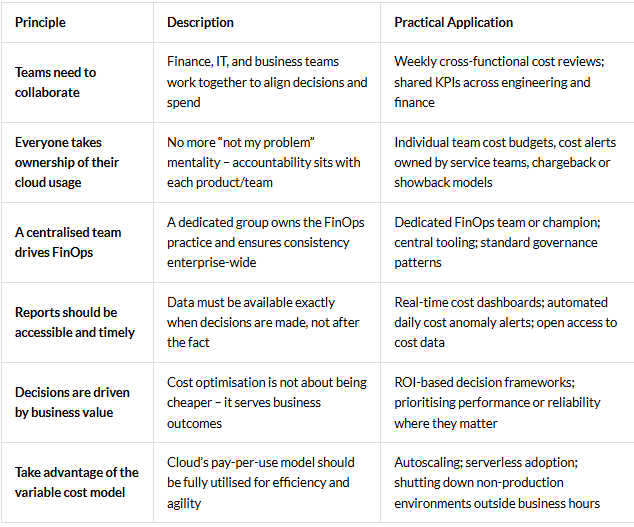
These FinOps principles work together like the components of a well-tuned engine. Remove any one element, and performance suffers dramatically.
What is a Cloud Cost Optimisation Strategy?
A cloud cost optimisation strategy is your master plan for achieving financial efficiency without sacrificing performance, security, or innovation. It’s the difference between random cost-cutting exercises and systematic value creation.
Core Components of an Effective Strategy:
- Visibility Framework
- Unified cost reporting across all cloud providers
- Granular cost allocation to business units and projects
- Real-time usage monitoring and alerting systems
2. Governance Structure
- Clear approval processes for large deployments
- Automated policies that prevent costly mistakes
- Regular architecture reviews focused on cost efficiency
3. Optimisation Playbook
- Standardised approaches to right-sizing resources
- Guidelines for selecting appropriate instance types
- Procedures for managing reserved capacity
4. Cultural Integration
- Cost awareness training for all cloud users
- Incentive structures that reward efficiency
- Regular communication about cost performance
Your strategy should complement your broader cloud transformation objectives, not conflict with them. The goal is sustainable growth, not just cost reduction.
How Can FinOps Help Reduce Cloud Spend?
The question isn’t whether FinOps can reduce your cloud spend. But it’s by how much and how quickly. Based on real-world implementations, organisations typically see:
Immediate Wins (0–3 months):
- 15–25% reduction from eliminating obvious waste
- 5–10% savings from basic right-sizing exercises
- Immediate cost visibility preventing surprise bills
Medium-term Gains (3–12 months):
- 20–30% total cost reduction through systematic optimisation
- Improved budget predictability and planning
- Enhanced resource utilisation rates
Long-term Value (12+ months):
- Cost-aware development practices become standard
- Automatic scaling reduces over-provisioning
- Strategic cloud architecture decisions drive ongoing efficiency
What is a FinOps Maturity Model?
The FinOps maturity model isn’t about reaching some arbitrary “level 5” status. It’s about understanding where you are and plotting the most effective path forward. Think of it as your roadmap from cost chaos to financial mastery.
Crawl Phase (Foundation)
- Basic cost visibility across major services
- Monthly cost reviews and reporting
- Simple tagging and allocation strategies
- Reactive cost management approach
Walk Phase (Optimisation)
- Automated cost monitoring and alerting
- Regular optimisation reviews and actions
- Cross-functional collaboration on cost decisions
- Proactive identification of waste and opportunities
Run Phase (Excellence)
- Real-time cost optimisation integrated into operations
- Predictive cost modelling and capacity planning
- Cost considerations built into all architectural decisions
- Continuous improvement culture around cloud efficiency
Most organisations spend 6–12 months in each phase, but the timeline depends on your starting point and commitment level.
Your cloud cost management journey deserves a partner with a proven playbook. Our FinOps consulting turns complex cloud bills into clear, actionable data. Ready to optimise your cloud spend and secure your profits? Schedule a custom consultation with us!
What Are Managed FinOps Services?
Not every organisation has the luxury of building an internal FinOps team from scratch. That’s where managed FinOps services become your secret weapon. It provides expertise, tools, and ongoing support without the overhead of hiring and training specialist staff.
What Managed FinOps Services Include:
Strategic Consulting:
- Initial cost assessment and baseline establishment
- Custom FinOps implementation roadmap
- Architecture reviews focused on cost efficiency
Operational Management:
- 24/7 cost monitoring and alerting
- Regular optimisation recommendations
- Monthly cost analysis and reporting
Technical Implementation:
- Tool selection and configuration
- Automated policy implementation
- Integration with existing systems
Ongoing Support:
- Training for your internal teams
- Regular strategy reviews and updates
- Access to FinOps expertise and best practices
The beauty of managed services is that you get enterprise-level FinOps capabilities without the enterprise-level investment in people and tools.
How to Get Started with Cloud Cost Management?
Cloud cost management journey doesn’t need a massive transformation project or a six-figure budget. The most successful implementations begin with small, focused steps that build momentum and reap value.
Week 1–2: Quick Wins
- Enable cost reporting on all cloud accounts
- Identify the top 10 cost contributors in your environment
- Look for obvious waste (unused resources, oversized instances)
- Set up basic budget alerts to prevent surprises
Month 1: Foundation Building
- Implement basic resource tagging across critical resources
- Create simple cost dashboards that key stakeholders can understand
- Schedule weekly cost reviews with relevant team members
- Document current spending patterns and trends
Month 2–3: Systematic Optimisation
- Right-size instances based on actual usage data
- Implement reserved instances for predictable workloads
- Establish cost allocation to business units or projects
- Begin regular optimisation cycles
Month 4–6: Culture Development
- Expand team training on cost-conscious cloud practices
- Integrate cost considerations into architectural decisions
- Develop governance policies that prevent costly mistakes
- Plan for advanced FinOps practices
Common FinOps Challenges and How to Overcome Them
Even the best-planned FinOps initiatives encounter obstacles. The key is anticipating these challenges and having strategies ready to address them.
Challenge 1: Lack of Cross-Functional Collaboration
The biggest barrier to FinOps success is cultural. When finance, IT, and business teams operate in silos, cost optimisation becomes a game of finger-pointing rather than problem-solving.
Solution: Start with shared metrics and regular communication. Create dashboards that everyone can understand. Schedule weekly reviews where all stakeholders contribute to cost decisions.
Challenge 2: Tool Sprawl and Data Fragmentation
Many organisations discover they have cost data scattered across tools, cloud providers, and reporting systems. This fragmentation makes it impossible to get a clear picture of total spend.
Solution: Invest in unified cost management platforms that aggregate data from all sources. Prioritise tools that integrate with your existing systems rather than creating additional silos.
Challenge 3: Resistance to Change
Development teams often resist cost optimisation efforts, viewing them as obstacles to innovation and speed. This resistance can undermine even the most well-intentioned FinOps initiatives.
Solution: Frame cost optimisation as enabling innovation, not constraining it. Show teams how efficient resource usage allows for more experimentation and faster iterations within budget constraints.
For the complete, end-to-end strategic map that covers optimising cloud, scaling with modern architecture, and securing your entire environment, read our master guide: The Strategic Guide to Cloud Transformation.
Frequently Asked Questions on FinOps
How long does it take to see results from FinOps implementation?
Most organisations see immediate wins within 2–4 weeks with substantial results (20–30% cost reduction). This is typically achieved within 3–6 months of systematic implementation.
Do I need dedicated FinOps staff to be successful?
No, you don’t need a dedicated FinOps staff to be successful. Large organisations often benefit from dedicated teams. Smaller companies can succeed with a part-time FinOps champion like Emvigo and land managed services support.
Can FinOps work with multi-cloud environments?
Yes, FinOps can work with multi-cloud environments. FinOps becomes even more valuable in multi-cloud scenarios where cost complexity increases exponentially. Unified reporting and governance become critical success factors.
What’s the typical ROI of FinOps implementation?
Most organisations achieve 3–5x ROI within the first year through direct cost savings alone. When you factor in improved budget predictability and resource efficiency, the value multiplies significantly.
How does FinOps impact development team productivity?
When implemented correctly, FinOps enhances productivity by providing clear cost guidelines, preventing budget surprises, and enabling more predictable planning cycles.
The Future is Financially Intelligent with FinOps
By implementing FinOps, you’re not merely saving money. You create a smart business that can succeed in a digital economy. In this economy, every dollar spent in the cloud is a smart investment. You’re creating an organisation that can scale efficiently, innovate sustainably, and compete effectively in an increasingly cloud-native world.
Your cloud journey deserves a partner who understands both the technical and the financial terrain. The road ahead is complex, but with the right guidance, it’s also incredibly rewarding.
Ready to transform your cloud costs from a source of anxiety into a competitive advantage?
Don’t let another month of uncontrolled spending slip by. Emvigo’s FinOps experts have guided dozens of businesses through successful cost optimisation journeys. This has helped them in reducing cloud spend by 25–40% within six months.
Start your financial transformation today. Get a comprehensive cloud cost assessment that reveals exactly where your money is going and how to redirect it for maximum impact.