
Abstract
Artificial Intelligence (AI) is rapidly transforming the global economy by improving productivity, enabling innovation, and reshaping industries. AI technologies allow businesses and governments to analyze large volumes of data, automate complex tasks, and make faster, more accurate decisions. This transformation is creating new economic opportunities while also changing the nature of work and investment. As an AI adoption continues to grow, it is expected to significantly contribute to global economic growth, improve operational efficiency, and create new industries. This article explores how AI is influencing the global economy, its impact on businesses and jobs, and the potential future economic outcomes driven by AI innovation.
Introduction
Artificial Intelligence has emerged as one of the most powerful technologies of the 21st century, influencing nearly every sector of the global economy. From healthcare and finance to manufacturing and retail, AI is enabling organizations to operate more efficiently and competitively. The increasing availability of data, combined with advances in machine learning, cloud computing, and automation, has accelerated AI adoption worldwide.
Businesses are using AI to improve decision-making, automate repetitive processes, and enhance customer experiences. Governments are investing heavily in AI to strengthen economic growth, improve public services, and gain global technological leadership. As a result, AI is becoming a key driver of economic transformation, reshaping how industries function and how value is created in the modern economy.
Understanding the economic impact of AI is essential because it affects productivity, employment, global competition, and long-term economic development.
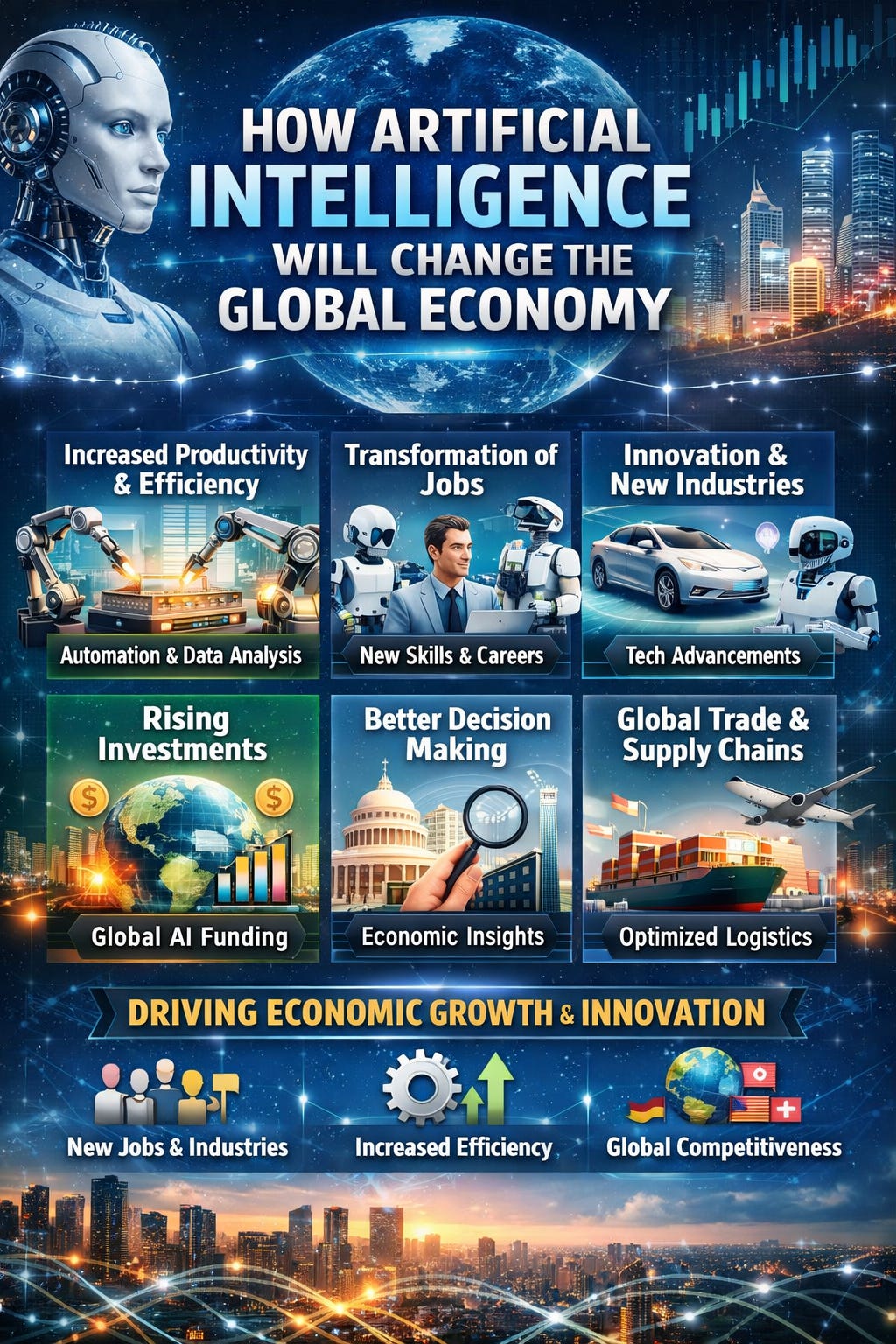
1. Increased Productivity and Efficiency
One of the most important economic impacts of AI is its ability to improve productivity. AI systems can automate repetitive and time-consuming tasks, allowing businesses to operate more efficiently. For example, AI can process and analyze large datasets quickly, helping companies identify trends, optimize operations, and reduce operational costs.
Automation reduces human workload and allows employees to focus on higher-value tasks such as strategy, innovation, and problem-solving. This leads to increased efficiency, improved performance, and higher economic output.
2. Transformation of the Labor Market
AI is changing the nature of jobs across industries. Some routine and manual jobs may be automated, but AI is also creating new job opportunities in areas such as:
- Data science
- Machine learning engineering
- AI development
- Robotics
- AI ethics and governance
Workers will need to develop new skills and adapt to AI-driven work environments. This shift will encourage continuous learning and create a more technologically skilled workforce.
3. Innovation and Creation of New Industries
AI is driving innovation by enabling new products, services, and business models. For example:
- Healthcare uses AI for disease detection and personalized treatment.
- Finance uses AI for fraud detection and risk analysis.
- Manufacturing uses AI for predictive maintenance and automation.
- Retail uses AI for recommendation systems and customer analytics.
AI is also creating entirely new industries such as autonomous vehicles, smart cities, and generative AI platforms. These industries are contributing to economic growth and job creation.
4. Increased Investment and Global Competition
Governments and companies worldwide are investing heavily in AI research and development. AI has become a strategic priority because countries that lead in AI will have a strong economic and technological advantage.
Large technology companies are investing billions of dollars in AI to improve products, expand services, and increase competitiveness. Venture capital firms are also funding AI startups, accelerating innovation and economic growth.
5. Improved Decision-Making and Economic Planning
AI helps organizations and governments make better decisions by analyzing economic data and predicting trends. Businesses can use AI to forecast demand, optimize pricing, and improve supply chain management.
Governments can use AI to improve public services, manage infrastructure, and develop more effective economic policies. This leads to better resource utilization and stronger economic stability.
6. Global Supply Chain and Trade Optimization
AI improves supply chain efficiency by predicting demand, optimizing logistics, and reducing delays. Businesses can manage inventory more effectively and reduce operational costs.
This improves global trade efficiency and helps businesses operate more reliably in international markets.
Conclusion
Artificial Intelligence is fundamentally reshaping the global economy by improving productivity, enabling innovation, and transforming industries. It is creating new economic opportunities while changing how businesses operate and how people work. AI is driving investment, improving decision-making, and enabling the creation of new industries.
Although AI presents challenges such as job displacement and ethical concerns, its overall economic impact is highly positive. Organizations and governments that invest in AI and develop AI-related skills will be better positioned for future economic success.
AI is not just a technological advancement; it is a major economic force that will shape the future of the global economy.
Future Outcomes
The future economic impact of AI will be even more significant as AI technologies continue to evolve. Several key outcomes are expected:
AI will create millions of new jobs, especially in technology-related fields, while transforming traditional roles. Workers who develop AI-related skills will have better career opportunities and higher earning potential.
AI will increase global economic output by improving efficiency and productivity across industries. Businesses will operate faster, smarter, and more efficiently.
New AI-driven industries such as autonomous transportation, AI-powered healthcare, and intelligent automation will continue to grow, creating new markets and economic opportunities.
Countries that invest heavily in AI education, infrastructure, and innovation will become global economic leaders. AI will play a key role in determining future economic power.
AI will also improve quality of life by enhancing healthcare, education, transportation, and public services.
In the long term, AI will become a core foundation of the global economy, driving innovation, economic growth, and technological progress.
Writer : Swaraj Verma
— Bhuwan Chettri
Editor, CodeToDeploy
CodeToDeploy Is a Tech-Focused Publication Helping Students, Professionals, And Creators Stay Ahead with AI, Coding, Cloud, Digital Tools, And Career Growth Insights.