
Understanding Candlestick Charts for Stock Investment with Python.

Candlestick Charts matter in stock investment — Why?
Candlestick charts are the language of the stock market. Whether the investors are investing Rs. 500 or Rs 5,00,000, candlestick charts help us understand:
1. Market philosophy
2. Price direction
3. Buying and selling pressure, and Entry and exit points
Unlike simple line charts, candlesticks show 4(four) crucial values at once:
Open, High, Low, and Close(OHLC)
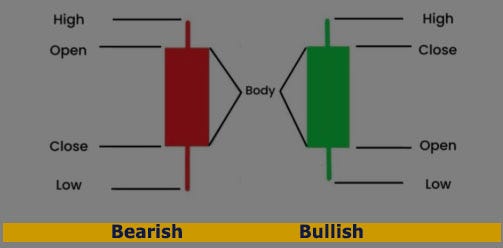
These make investors extremely powerful for both short-term traders and long-term investors.
Candlestick charts help answer critical questions:
1. Are buyers stronger than sellers?
2. Is the trend reversing?
3. Should I Wait, Buy, or Exit?
This is why candlesticks are used in:
1. Equity trading.
2. ETF analysis, and
3. Momentum investing, and
4. Swing trading
Most important Candlestick patterns:
1. Doji: Market confusion
2. Open ≈ Close
3. Signals indecision
Often appears before reversals.
Investors’ insight: “Do not trade immediately after a Doji; wait for confirmation.”
Hammer — Possible Trend Reversal
1. Small body
2. Long Lower shadow
3. Appears after a downtrend
Meaning: Buyers are stepping in.
Shooting Star — Warning signal
1. Small body
2. Long upper shadow
3. Appears after a downtrend.
Meaning: Sellers may take control.
Bullish Engulfing: Strong Buy Signal
The green candle completely covers the previous red candle.
Bearish Engulfing: Exit signal
Red Candle engulfs the previous green candle. Indicates selling pressure.
Candlestick Charts with Python means “Smart Investing”.
Now, visualize a Candlestick with Python, which helps in:
1. Data-driven investing
2. Back testing strategies, and
3. Learning technical analysis logically.
Using Real Stock Data from yfinance: Library Installation
pip install yfinance mplfinance pandasPython Full code:
import pandas as pd
import numpy as np
import yfinance as yf

# Download data
df = yf.download("AAPL", period="2y", interval="1d")

# Fix MultiIndex columns
if isinstance(df.columns, pd.MultiIndex):
    df.columns = df.columns.get_level_values(0)

# Convert OHLC to numeric
ohlc_cols = ['Open', 'High', 'Low', 'Close', 'Volume']
for col in ohlc_cols:
    df[col] = pd.to_numeric(df[col], errors='coerce')

# Drop bad rows
df.dropna(subset=ohlc_cols, inplace=True)

print(df.dtypes)
Output:
Open      float64
High      float64
Low       float64
Close     float64
Volume int64Conclusion:
Candlestick-based machine learning models help convert price charts into meaningful numerical signals. By cleaning OHLC data, engineering candlestick features, and applying ML algorithms, we move from visual intuition to data-driven investment decisions. While no model can predict markets perfectly, even modest accuracy, when combined with discipline and risk management, can provide a consistent edge. Candlesticks, when paired with Python and Machine Learning, form a powerful foundation for modern, intelligent investing.
Interested in making money by investing smartly?
Read my previous article: Stock Market Invest in ETFs and Momentum ETFs