
In the span of a few years, AI in software development has evolved from a novel convenience into a core part of how code is crafted, reviewed, debugged, tested, and shipped. By 2026, that evolution has reshaped not only developer productivity but also the very definition of what it means to “write code.”
Today’s AI coding tools are no longer just autocomplete assistants. They operate as autonomous agents — collaborators that plan, execute, test, iterate, and even commit code with minimal human intervention.
The Paradigm Shift: From Assistants to Agents
The transition from 2023 to 2026 has been marked by three distinct eras:
- Autocomplete Assistants (Past Era): Early tools like the initial GitHub Copilot saved keystrokes by reducing boilerplate. They were “predictive,” but lacked the ability to understand the intent behind a complex feature.
- Conversational AI Coding (Transitional Era): ChatGPT and Claude introduced chat-based generation. Developers could describe intent, but the process was manual: copy, paste, fix, repeat.
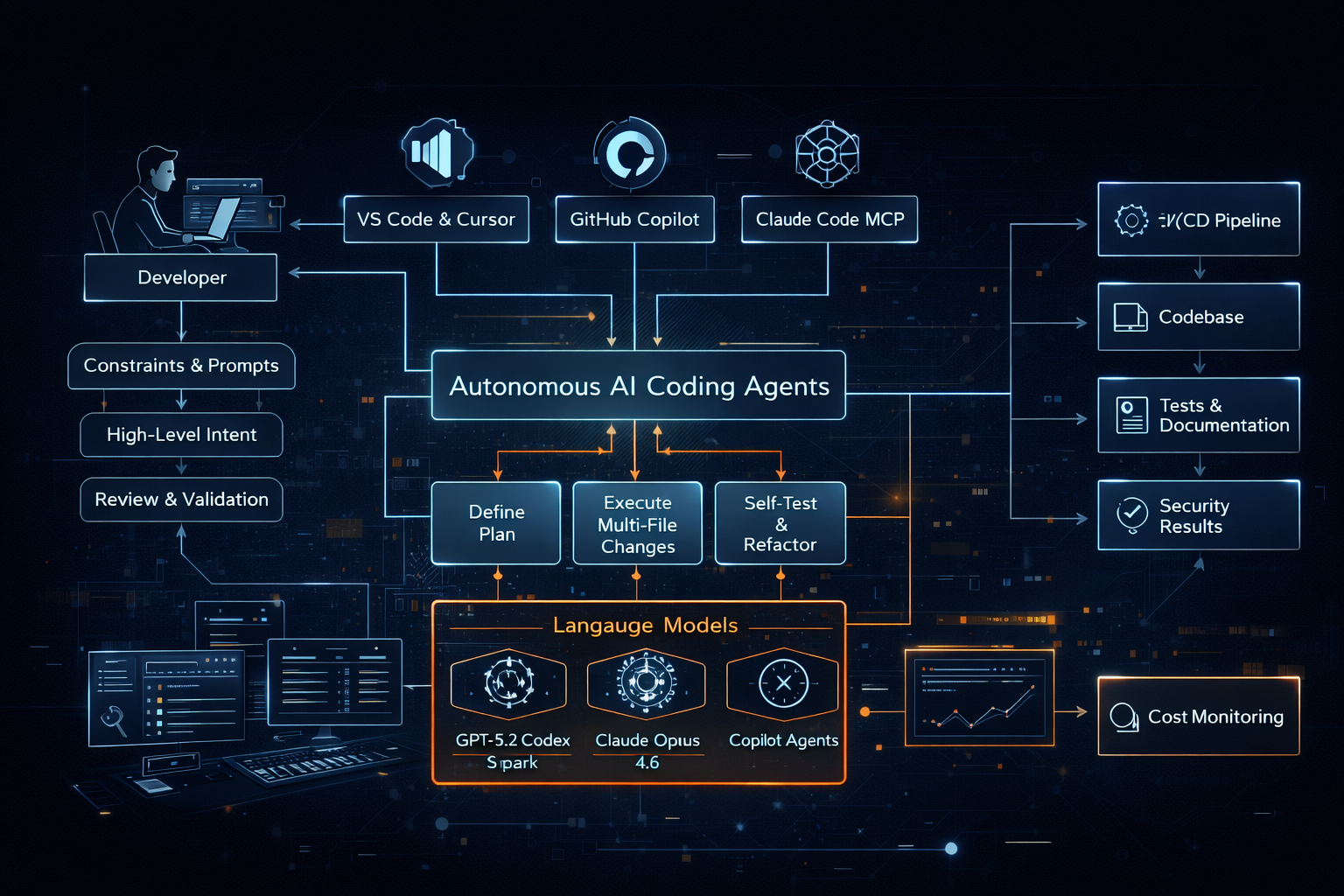
- Autonomous AI Agents (Current Era): Today, we utilize Multi-Agent Systems (MAS). These are not just LLMs in a box; they are specialized programs that:
- Context-Map Repositories: Read and understand entire codebases, including the dependency graph.
- Execute Multi-File Changes: Modify a front-end component, the back-end API, and the database schema simultaneously to ensure consistency.
- Self-Heal: Run tests, catch errors in the terminal, and refactor their own code until the build passes.
- Asynchronous Labor: Work in the background on a branch while you focus on high-level architecture.
The Leading AI Coding Tools and Models (2026)
1. GitHub Copilot + Copilot Agents
GitHub remains the standard, but it has shifted from a plugin to a full-lifecycle agent.
- Copilot Workspace: An environment where you start with a GitHub Issue and Copilot generates a “plan” (a technical spec), then converts that plan into a Pull Request.
- Copilot CLI: Now supports Agent Mode, allowing you to run
copilot task "migrate the auth module to OAuth2"directly in the terminal. - Integration: Deeply integrated with GitHub Actions to provide “Self-Healing CI/CD,” where AI automatically fixes failing builds.
2. Claude Code & Claude Opus 4.6
Anthropic’s Claude Code is the preferred choice for complex reasoning and large-scale refactors.
- Massive Context: With the release of Claude Opus 4.6 in early 2026, developers now have access to a 1M token context window, allowing the model to “remember” every single file in most commercial projects.
- MCP (Model Context Protocol): Claude now uses MCP to securely connect to your local files, databases, and even Slack, allowing it to act based on team conversations.
- Thinking Mode: Introduces Adaptive Thinking, where the model pauses to “reason” through a logic problem before writing a single line of code.
3. OpenAI Codex (GPT-5.3 Spark)
OpenAI’s latest iteration, GPT-5.3-Codex-Spark, focuses on low-latency, real-time collaboration.
- Speed: Designed to be 15x faster than previous models, making it the engine for ultra-responsive IDEs.
- Cybersecurity Focus: Classified as “High Capability” for finding security vulnerabilities during the generation process, preventing SQL injections and memory leaks before they reach production.
4. Cursor
Cursor is no longer just a “VS Code fork” — it is the industry-standard AI-Native IDE.
- Composer Mode: Allows you to edit 10+ files at once using a single natural language prompt.
- Shadow Workspace: Cursor runs a hidden background instance of your code to verify that AI suggestions actually compile before showing them to you.
- Cursor Blame: A 2026 feature that uses AI to distinguish between code written by humans, “Tab” completions, and autonomous agent runs for better team auditing.
How to Use AI Agents Effectively
To get the most out of these tools in 2026, you must stop treating them as “chatbots” and start treating them as “employees.”
Phase 1: Setting the “Laws” (Project Configuration)
Don’t repeat yourself. Use rule files to define your architecture once.
For Cursor: Create a .cursorrules file in your root directory.Example Content: “Always use TypeScript. Prefer functional components over classes. Use Tailwind CSS for styling. Never use any."For Copilot: Create a .github/copilot-instructions.md file.Phase 2: The “Plan-Act-Check” Workflow
- Plan: Use Plan Mode (Shift + Tab in Cursor 2.0). Ask: “Plan a refactor for the user-service to include multi-factor authentication.”
- Review the Plan: The agent will output a Markdown list of files it intends to change. Edit this plan if you disagree with the architecture.
- Act: Click “Apply.” The agent will now execute the multi-file edits in a “Shadow Workspace.”
- Check: Run your test suite. If it fails, type: “The tests failed with Error X. Fix the implementation.”
Phase 3: Terminal Automation
Use Claude Code or Copilot CLI to handle the “drudge work”:
claude-code run "Update all dependencies in package.json and fix breaking changes"copilot task "Find all unused exports in the /src folder and delete them"
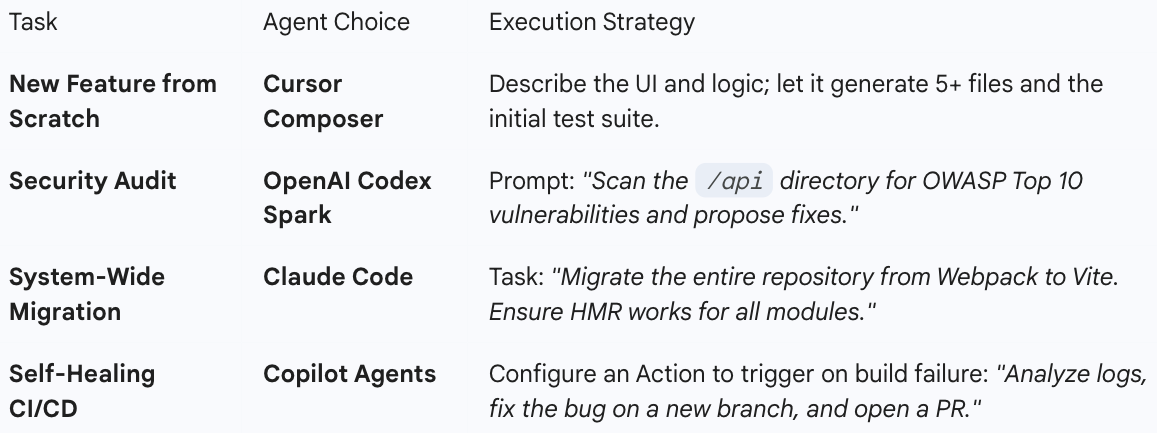
Real-World Workflow Examples
Pros & Cons of Agentic Coding in 2026
The Pros
- Drastic Velocity: Teams are shipping features 3–4x faster than in 2023.
- Lower Barrier to Entry: Junior developers can contribute to complex systems by “orchestrating” agents that handle the syntax.
- Reduced Technical Debt: Agents can be scheduled to refactor “messy” code in the background during off-hours.
The Cons
- “Vibe Coding” Hallucinations: High-speed generation can lead to “subtle bugs” — logic that looks correct but fails in edge cases.
- Security Risks: Without strict human review, agents may accidentally propagate insecure patterns found in older training data.
- Knowledge Atrophy: Over-reliance on agents can lead to “brain rot,” where developers lose the ability to debug without AI assistance.
- Cost Management: Agentic runs (especially with 1M context models like Claude 4.6) can be expensive if not monitored.
The New Role of the Developer: The Orchestrator
The “Junior Developer” role is being redefined. With AI generating 41% of all worldwide code this year, the human bottleneck has moved from writing to governing.
Shift From
Syntax Proficiency
Manual Debugging
Individual Contributor
Writing Boilerplate
Shift To
System Architecture
Prompt Engineering & Validation
Agent Orchestrator
Security & Ethical Oversight
Conclusion
Coding with AI in 2026 is a standard requirement, not a bonus skill. We have moved past “autocomplete” into a world of Centaur Systems, where human intuition and machine execution work in a seamless loop. The goal is no longer just to “ship code,” but to guide agents to build reliable, scalable, and secure systems.