
As tools like Copilot and ChatGPT take over "junior work," the real advantage shifts from typing syntax to directing systems, products, and AI itself.
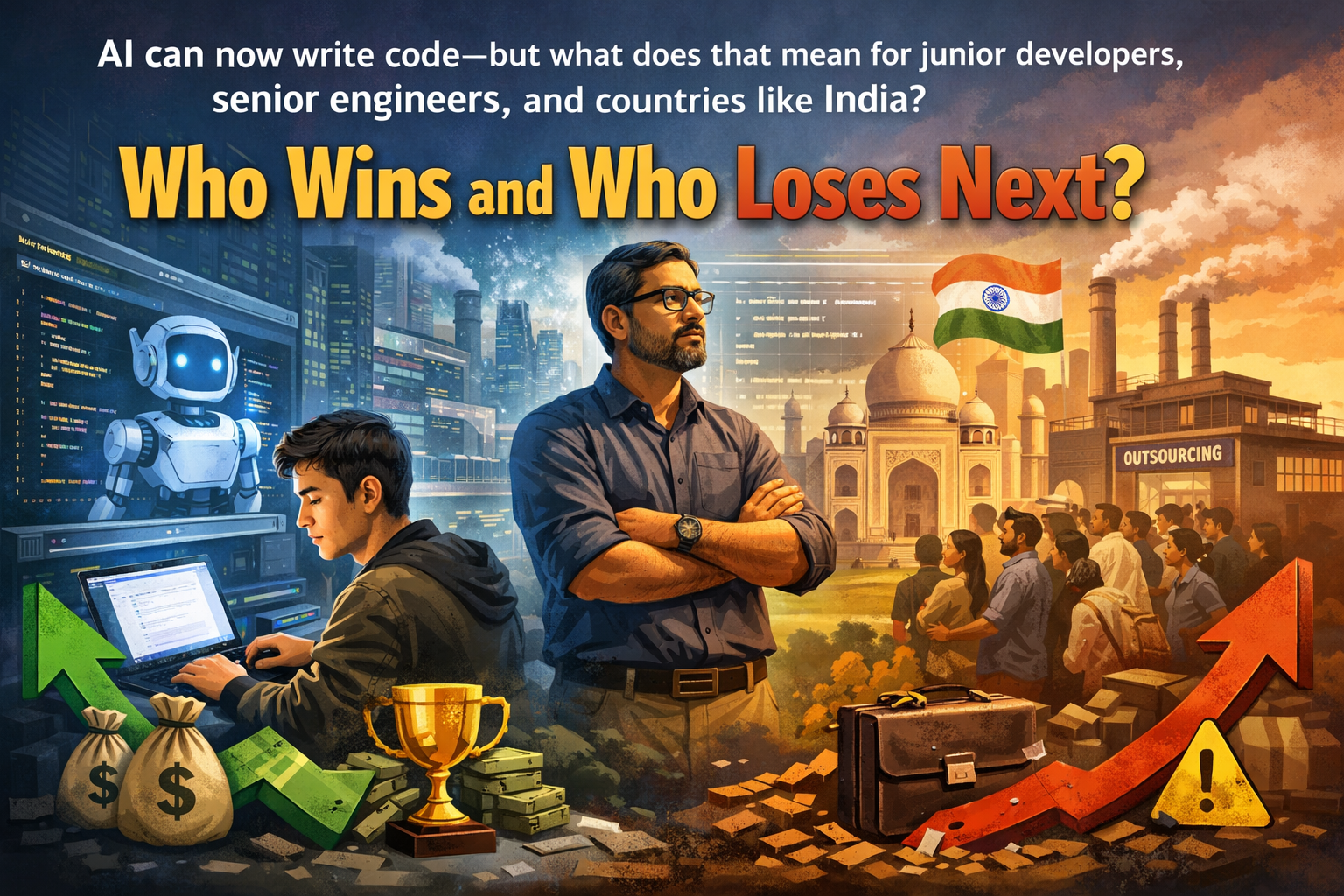
AI can now write better code than some junior developers. So what happens to their careers next. That's the question Silicon Valley doesn't really want to answer out loud. In my previous article, I explored the divide between Sundar Pichai and Sridhar Vembu on "vibe coding" - one frames AI as acceleration, the other warns against shallow engineering culture. But beyond the debate lies something more personal: what happens to software careers in a world where machines code. what happens to software careers in a world where machines code. Is this empowerment, or is it displacement? Let’s look at that honestly.
🔥 Top Tech Jobs Are Hiring NOW — Don’t Miss Out.
👉 Apply & Secure Your Job

The shift: from writing code to directing code
For decades, developers were valued for things like writing clean syntax, debugging complex logic, knowing frameworks deeply, and optimizing performance. Now tools like Copilot and ChatGPT can generate entire modules in seconds. The developer's role is subtly changing from "I write code" to "I guide the machine to write the right code." This is not just automation of typing; it is automation of a chunk of cognitive labor, and that changes career dynamics.
Who wins in the AI coding era
In this new landscape, some people gain a massive advantage.
1️⃣ The product-minded engineer
Engineers who understand user psychology, business models, system architecture, and trade-offs become more valuable. AI can generate 100 lines of code, but it still cannot decide what should be built, what should not be built, which trade-offs matter, or what technical debt is acceptable. The engineer who thinks beyond syntax wins.
2️⃣ The AI-augmented developer
Some developers fear AI; others use it like a superpower. AI does not eliminate good engineers - it amplifies them. A skilled developer using AI builds faster, experiments more, ships earlier, and tests multiple approaches. Instead of writing everything manually, they become strategic orchestrators whose productivity multiplies.
3️⃣ The non-traditional builder
This is the quiet revolution. Designers, marketers, founders, students - people who could not code before can now build working prototypes. AI lowers the barrier to entry, so innovation no longer stays locked inside computer science degrees.
Who might struggle
But not everyone benefits equally from this shift. Now comes the uncomfortable part.
1️⃣ Pure syntax coders
If someone's only edge is writing CRUD operations, basic backend APIs, or simple automation scripts, AI can already replicate much of that. The market rarely rewards repetitive skills once automation exists.
2️⃣ Entry-level roles
Many companies use junior developers for bug fixing, small feature development, and code documentation. AI can now assist with or partially replace these tasks, so some companies may hire fewer beginners and more experienced engineers who know how to supervise AI. This creates a funnel problem: if juniors don't get opportunities, how will they ever become seniors. The industry will have to solve this.
Is coding dying?
No. But coding is evolving. Calculators did not kill mathematics. Excel did not kill accountants. Google did not kill researchers. Likewise, AI will not kill developers - it will change what developers are really paid for.
The new survival skills
The future engineer may need a different stack of strengths: system thinking, domain expertise in areas like finance or healthcare, AI tool mastery, communication skills, and product intuition. Coding becomes one layer of identity, not the entire identity.
What this means for countries like India
Countries with large engineering workforces have even more at stake. If service-based, repetitive coding declines, India will need to move from execution to ownership, from outsourcing to product building, and from billing coding hours to creating innovation value. AI could either shrink opportunities or create a new generation of global tech leaders; the difference will depend on how fast we adapt.
The real divide
The debate between tech leaders is interesting, but the deepest divide is not ideological - it is psychological. Between those who adapt and those who resist. The AI era does not ask for permission. If you want to see how these tradeoffs play out in systems like healthcare and education, I explore that in my follow-up essay, “When ‘Move Fast and Break Things’ Breaks People.”
How Is AI Changing Your Work?
I'm curious where you stand in all this: does AI feel more like a threat to your role or a superpower you're still learning to use? If you've already seen AI change how your team works - for better or worse - tell me about it in the comments. And if you want more honest takes on vibe coding, software careers, and the future of work, consider following me here on Medium so you don't miss the next piece.
Writer : Rekha