
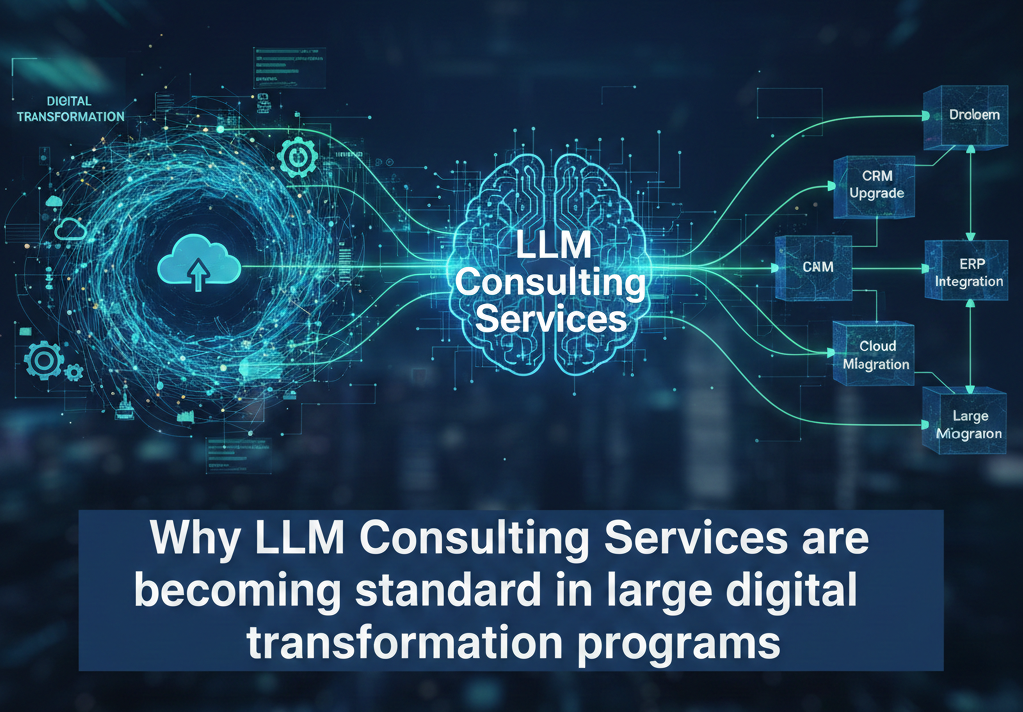
Enterprise digital transformation has reached a new phase. Infrastructure modernization and cloud adoption are no longer sufficient to gain a sustainable edge.
Today’s transformation leaders are intelligence at scale focused. They want systems that understand context, reason over not structured data and support decisions across the organization. This shift explains why LLM Consulting Services are no longer considered as optional experimentation but as a fundamental part of large transformation programs.
Global enterprises and powerful startups have a similar struggle. Language models are promising fast, but many initiatives get stuck after pilot stages. It is rarely technical capability that causes the gap. It is strategic alignment, governance and depth of integration. Consulting-led adoption has become the mechanism that converts potential into sustained business value.
From Isolated AI Projects to Transformation Infrastructure
Early AI adoption focused on proof of concept. Teams tested models in silos, often disconnected from core systems. These experiments provided information but did not transform operations.
Modern transformation programs consider language models as a part of the foundational infrastructure. They impact customer engagement, internal knowledge flows, analytics and operational decision-making. This requires a different approach, one that tests business processes before technology choices are made.
Enterprises are increasingly counting on structured LLM Development Services to determine where language models make a measurable difference. Instead of using models everywhere, consulting frameworks can serve to prioritize use cases that are directly related to efficiency gains, risk reduction or revenue acceleration. Industry studies consistently show that AI initiatives that are aligned with transformation roadmaps are more successful than fragmented AI deployments.
Why Consulting Has Become a Baseline Requirement
Strategic Clarity for Executive Teams
Decision-makers are under pressure to demonstrate results, not prototypes. Consulting engagement offers a clear transposition of executive objectives to technical execution. It defines what success looks like prior to a model being deployed.
This clarity is especially critical in multi-year digital transformation initiatives where investments in AI have to coexist with the modernisation of legacy systems, security projects and regulatory limits.
Navigating Enterprise Complexity
Large organizations have a regional, business unit, and technology stack organization. Deploying language models in these sorts of environments is not always simple.
An experienced LLM Development Company brings discipline in architecture. Consultants evaluate data readiness, establish integration patterns, and design governance models that scale across the departments. This is to prevent the build-up of technical debt that often accompanies a rush to implement AI.
Governance and Risk Management
Enterprises cannot afford to have model behavior go out of control. Data leakage, biased outputs, or compliance violations may destroy trust in no time.
Consulting-led programs define policies around data usage, access control, monitoring and auditability; These controls are becoming aligned with global AI governance structures and regulatory activities. For many organizations, this layer in risk management is a big enough justification to make the consulting investment.
The Role of Customization in Transformation Outcomes
Generic language models are powerful, but they do not often match enterprise realities. Domain nuance, internal terminology and proprietary processes require customization.
Domain Intelligence Over General Knowledge
Enterprises exist in specialized environments such as finance, healthcare, logistics or manufacturing. Many models that have been trained on public data only encounter difficulties in domain-specific reasoning.
Custom LLM Development Organizations can tailor base models with internal data, structured knowledge, and specific task tuning. The outcome is increased accuracy and greater trust by users who rely on consistent outputs to make daily decisions.
Practical Integration With Existing Systems
Digital transformation does not generally replace everything at once. Legacy platforms have been critical to operations for years.
Through LLM Integration Services, consultants integrate language models into existing workflows rather than disruptive replacements. This can mean integration with document repositories, CRM systems, analytics tools or internal support systems. Adoption is enhanced when intelligence is a natural fit with the way teams already work.
Cost, Scale, and Operational Discipline
Language models open up new cost dynamics. Compute usage, inference latency and maintenance requirements can quickly spiral out of control without careful planning.
Consulting frameworks: The goal of these frameworks is to help organizations pick strategies to deploy that are proportional to actual demand. Whether models are hosted privately, consumed via managed APIs, or deployed in a hybrid setting, decisions are bound to cost control and performance goals.
Scalability planning is also important. Transformation programs have often begun with a small agenda and quickly expanded. Well-architected LLM-Powered Solutions remain reliable as the number of users increases across teams and regions without performance bottlenecks that derail adoption.
Competitive Pressure and Market Expectations
Market dynamics are also involved in standardization. Boards, investors, and customers have come to expect intelligent systems to be part of enterprise offerings.
Organizations that make AI work for them are seeing measurable benefits in customer retention, internal efficiency and product differentiation. This performance gap puts pressure on peers to do the same.
For well-funded startups, adoption that is led by consultants allows for structure when scaling at a very fast pace. For enterprises, it decreases uncertainty but modernizes at speed. In both cases, consulting is a sign of maturity and intent.
What Decision-Makers Expect From Consulting Engagements
Transformation leaders usually seek partners that blend strategic thinking with execution ability. Effective engagements are:
- Identification of high-impact use cases that are aligned with transformation KPIs
- Architecture Design That Builds Balance between performance, security, and cost
- Model Customization as per internal data & Domain needs
- Integration planning that considers the existing systems
- Continuous optimization and governance support
Many organizations do not want to choose between advisory and build phases but want one engagement model that covers both. Providers who can offer both consulting and engineering capabilities reduce the handoff risk and increase time to value.
Long-Term Impact on Digital Transformation Programs
The standardization in the adoption of consulting is a reflection of a larger reality. Language models are no longer sidekick tools. They are becoming ingrained throughout enterprise systems.
As models mature, the role of model-based decision-making, automation, and knowledge management will become more advanced. Organizations that invest early in structured adoption frameworks are better positioned to make adaptations without rework after rework.
This is where solutions for custom LLM are proving their long-term worth. They evolve in tune with business needs, and do not become static implementation that needs to be replaced.
Final Perspective
Large digital transformation programs are successful when the selection of technology is disciplined, aligned and governed. Consulting-led adoption of language models delivers just that — structure.
For enterprises and ambitious startups, the conversation is no longer about experimentation. Language models have become strategic assets. Bringing consulting expertise into the process early ensures these assets are deployed responsibly, scaled efficiently and tied directly to business outcomes that matter.