
Most knowledge workers are using AI wrong — and the interface is to blame.
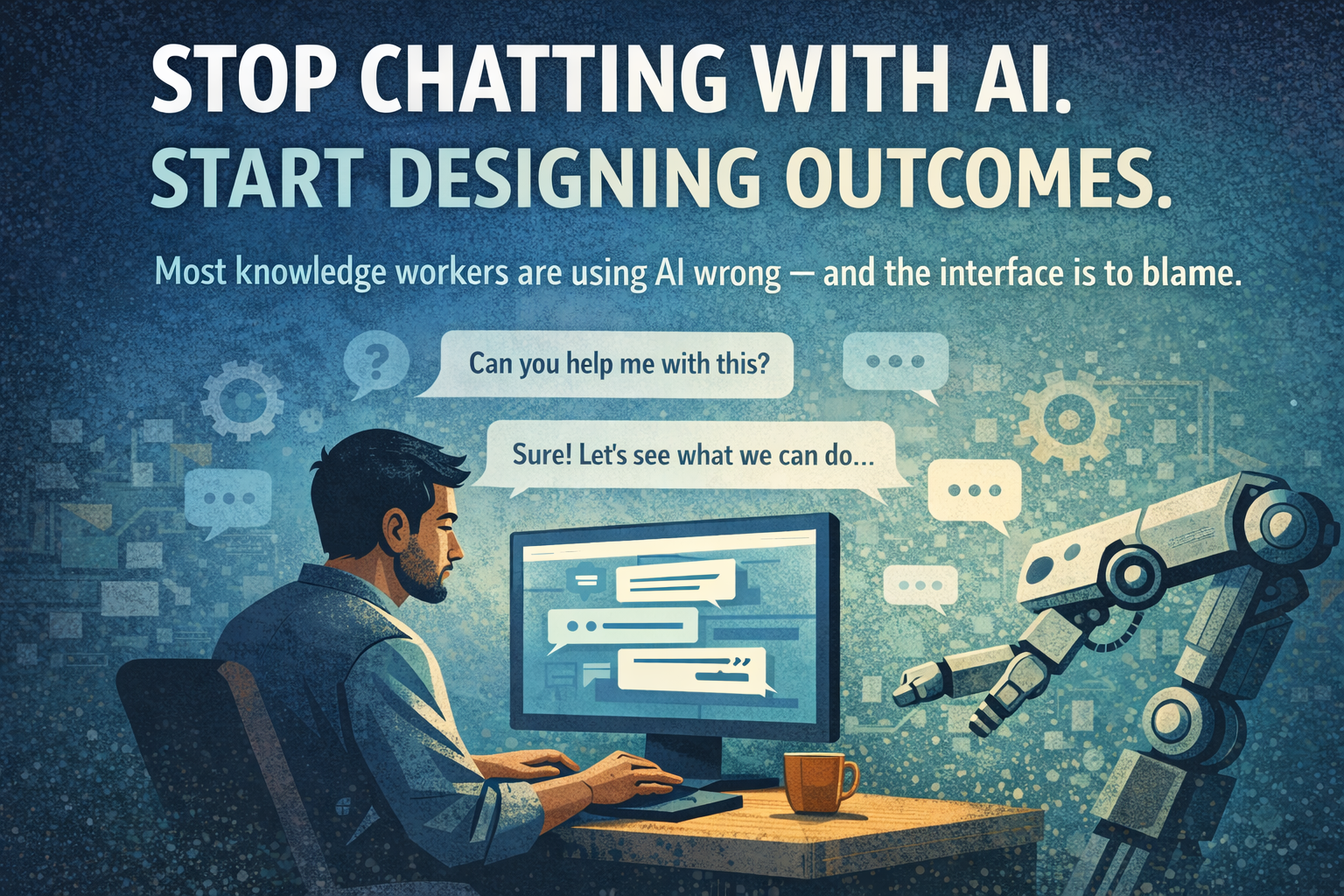
You’ve been trained to treat AI like a coworker.
You open a chat window. You type a polite request. You wait. You clarify. You tweak. You paste the result somewhere else.
It feels productive.
It isn’t.
The single biggest mistake knowledge workers are making right now is confusing conversation with execution. And millions of people are paying for that mistake — not in dollars, but in invisible overhead that compounds every single day.
The Chat Illusion (And Why It’s So Hard to See)
Chat interfaces are seductive. They make AI feel intelligent because it responds in full sentences. It sounds thoughtful. Sometimes even empathetic.
But here’s the uncomfortable truth most productivity influencers won’t tell you:
If you’re still explaining what you want step by step, you are doing coordination work the system should be doing for you.
You are acting as the project manager for a machine.
That’s backwards.
The interface wasn’t designed to make you more productive. It was designed to make AI feel approachable. Those are two completely different goals — and conflating them is costing you hours every week.
Why Chat Breaks the Moment Work Gets Real
Chat works beautifully for brainstorming, rough drafts, and idea exploration. Nobody disputes that.
But it breaks — hard — the moment you need repetitive workflows, cross-tool automation, production-grade consistency, or outputs that feed downstream systems.
Why?
Because chat is probabilistic by nature.
Ask for the same thing three times and you get three different responses. That’s fine when you’re exploring ideas. It becomes a serious liability when you’re generating invoices, code modules, legal summaries, compliance reports, or marketing assets that plug into real business pipelines.
Here’s the phrase that should be printed on every AI chat interface as a warning label:
Execution requires structure. Chat provides vibes.
The Real Bottleneck Isn’t the Model — It’s the Translation Layer
The models are smart enough. GPT-4, Claude, Gemini — at this point, raw intelligence is not the constraint.
The bottleneck is translation.
When you click a button in software, something precise happens. A function runs with exact parameters. The output is deterministic. You get what you asked for, every time.
When you chat with AI, you’re speaking in generalities while the system underneath needs structure. So something gets lost. And that gap has to be filled by someone.
That someone is you.
You reformat output. You extract relevant pieces. You copy and paste. You adjust formatting. You manually move data between tools.
The AI did the thinking. You did the plumbing.
That’s not automation. That’s assisted typing — and it’s a far cry from the productivity revolution that was promised.
The Shift That Changes Everything: From Conversation to Declaration
There’s a higher-leverage way to work, and it starts with a mindset shift most people never make.
Stop asking. Start declaring.
Not: “Can you help me write a presentation about our Q3 results?”
But: “Create a 12-slide investor deck using these three source documents. Extract all financial highlights. Structure it around the problem-solution-traction narrative. Export as PDF.”
One instruction. No dialogue loop. No back-and-forth. No babysitting.
The system executes across tools and returns a finished artifact.
The difference between these two approaches isn’t intelligence. It isn’t even prompting skill.
It’s architecture.
One approach treats AI as a conversation partner. The other treats it as an execution engine. Only one of those scales.
Why Most People Never Reach This Level
Because chat demos beautifully.
It looks impressive in short bursts. Put it on a slide deck, show it in a demo call, use it in a YouTube thumbnail — chat is visual, dynamic, and immediately legible to anyone watching.
But over months of real work, something subtle and uncomfortable happens.
You realize you’re still toggling between apps. Still managing context manually. Still stitching outputs together with copy-paste and a prayer. AI made each individual tool slightly better, but the workflow connecting them? That’s still you.
You’re still the glue.
And glue work is invisible — which makes it dangerous. Nobody counts the minutes spent reformatting. Nobody tracks the cognitive load of context-switching. It just quietly drains energy and capacity every single day.
What Actually Changes When Execution Becomes Autonomous
When systems are structured to execute without requiring conversation, three things shift simultaneously.
Planning becomes the skill. You stop spending mental energy on phrasing and start spending it on architecture. What outcome do I need? What inputs does the system need to produce it? That’s a higher-order cognitive activity — and it compounds.
Clarity becomes leverage. A vague prompt produces a vague result you then have to fix. A precisely declared outcome produces a finished artifact. The clarity you invest upfront pays dividends on every execution.
Output detaches from effort. The relationship between how hard you work and what you produce stops being linear. Systems run. Artifacts appear. Your job shifts from doing to directing.
This is what “AI leverage” actually means. Not typing faster. Not getting better at prompts. Designing systems that execute while you think about what to build next.
The Psychological Trap Nobody Talks About
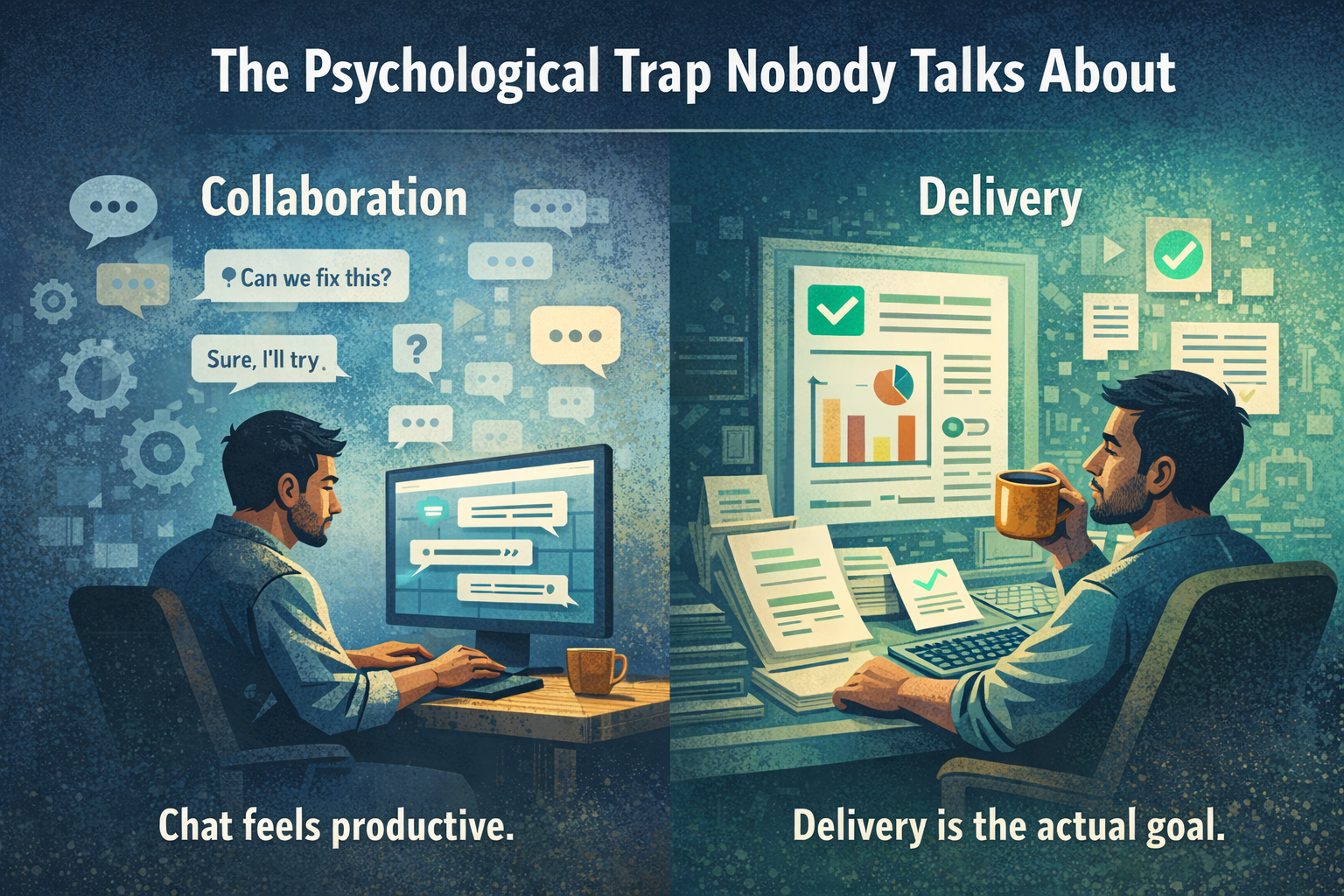
Chat feels productive because you’re active.
Typing. Reading. Responding. It mimics collaboration — and humans are wired to associate collaboration with progress.
But collaboration is not the goal. Delivery is.
If you need 12 back-and-forth messages to produce one finished asset, that friction doesn’t just cost you time. It costs you energy, flow state, and decision bandwidth. Now multiply that friction across 30 tasks a day.
That’s not intelligence amplification.
That’s overhead with extra steps.
The Future Isn’t Smarter Chat. It’s Fewer Conversations.
The next leap in AI productivity won’t come from better models. It won’t come from better prompts. It won’t come from longer context windows.
It will come from fewer prompts.
Systems that understand context automatically. That execute across tools without supervision. That produce finished, production-ready artifacts and ask for input only when genuinely necessary.
Not because they “understand” you better — but because they’re architecturally structured to execute deterministically within defined parameters.
The biggest unlock isn’t a new AI feature.
It’s a new mental model.
The Only Question That Matters
Here’s a diagnostic you can run right now.
Look at your AI usage over the last week. Be honest.
How much of it was thinking — exploring problems, generating novel ideas, stress-testing decisions?
And how much of it was coordinating — managing handoffs, reformatting output, clarifying misunderstandings, copy-pasting between tools?
If the coordinating work takes more time than the thinking work, you’re not leveraging AI.
You’re supervising it.
Stop chatting. Start designing systems that execute.
That’s where the real leverage has always been.
Found this useful? Follow for more on AI systems, knowledge work, and the gap between how AI is sold and how it actually performs at scale.