
Some careers bend in a downturn. These ones don’t even notice.
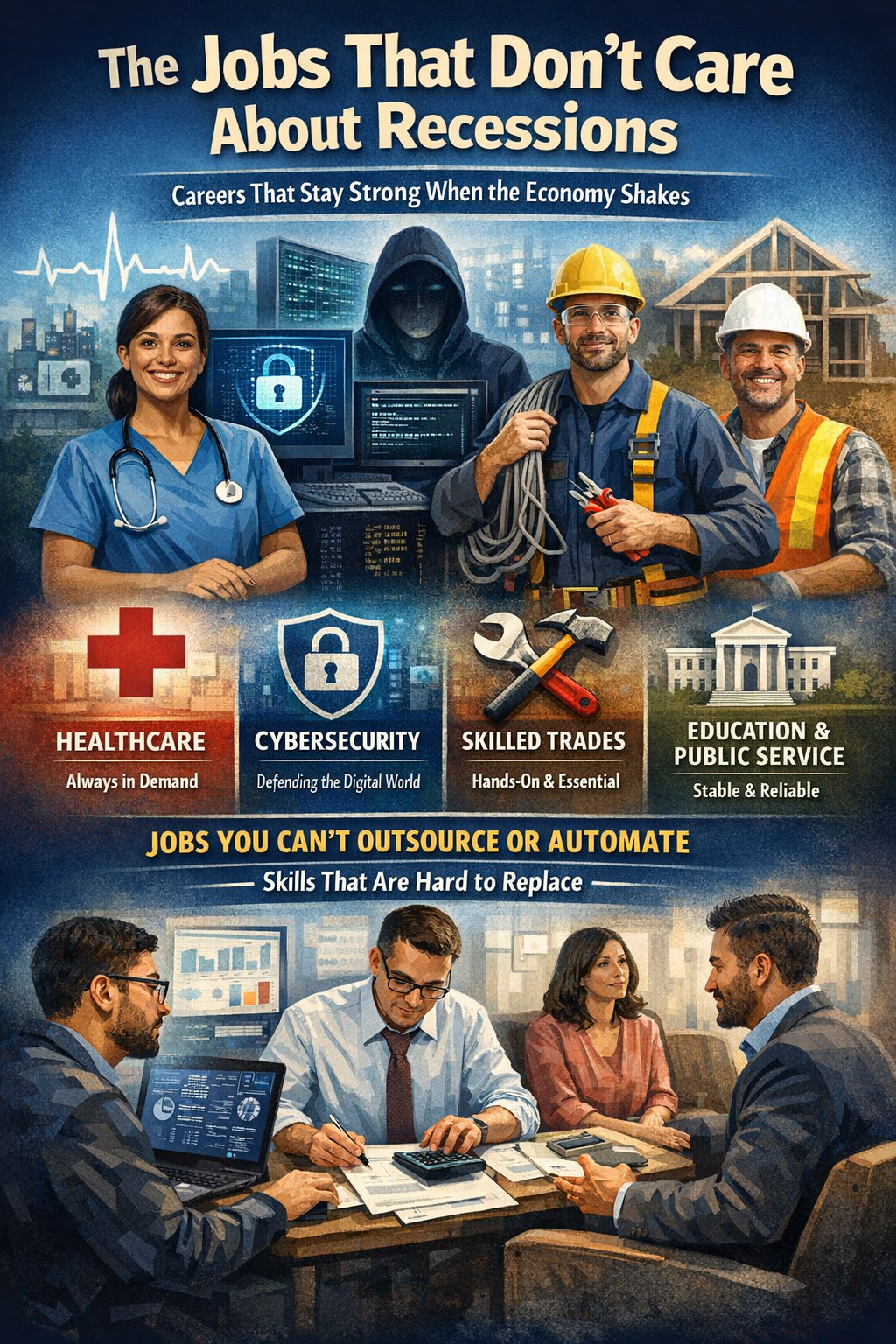
A few months ago, a friend of mine got laid off from a marketing role she’d held for six years. The company wasn’t failing. Revenue was fine. They just decided a couple of AI tools could handle what her team of four used to do. I track these tools pretty closely in my own work, and there are now dozens that can quietly erase whole categories of tasks.
🚀 High-Paying Tech Roles Are Open Right Now.
Apply Quickly — The Faster You Move, The Better Your Chance To Get Selected.
👉 Apply & Secure Your Job
If you’re curious what that looks like in practice, I rounded up some of the ones that actually work here: 25 Free AI Tools That Actually Work in 2026
She’s not unique. That story is playing out in offices everywhere right now.
What’s interesting, though, is that while some industries are shedding people at a frightening pace, others are desperately short-staffed and raising salaries to compete for workers. The two realities exist at the same time. You’re just not always hearing about the second one.
So what separates a career that weathers economic turbulence from one that doesn’t?
It usually comes down to one thing: whether the job requires something that’s genuinely hard to replace. A physical presence. A licensed human judgment call. Trust built over years. The ability to look someone in the eye when they’re scared.
Algorithms are impressive. They are not good at that.
Here’s how analysts actually measure job security — not with vibes, but with numbers. U.S. News and the Bureau of Labor Statistics track three things: current unemployment rates within a field, projected growth over the next decade, and overall demand trajectory. The careers that score well on all three tend to share a common thread: they’re embedded in needs that society can’t defer, digitize, or send overseas.
Below are the fields where that shows up most clearly.
Healthcare, first, because it’s not even close.
People don’t stop getting sick when the stock market drops. They don’t postpone strokes or skip chronic disease management because a recession is trending on Twitter. Healthcare is one of the only industries where a bad economy can actually increase demand — more stress, more deferred care coming back, more people aging into the system simultaneously.
Nurse Practitioners are probably the clearest example of this. They can diagnose, treat, and prescribe independently in most states, which makes them one of the most versatile and valuable roles in a system that’s perpetually understaffed. Growth in the field is running several times faster than the national average, and it’s showing no signs of slowing.
Physician Assistants are in a similar spot. Rural areas especially are depending on PAs to fill primary care gaps that aren’t going to close anytime soon. Their unemployment rate sits somewhere around 1–2%. That’s not a typo. In a functioning economy, that number is essentially the floor.
Physical Therapist Assistants don’t get as much press, but the projected growth rate of around 24% makes them hard to ignore. People are living longer. They’re also more active longer, which means more injuries, more post-surgical recovery, more long-term rehab. None of that work can be done remotely or handed off to a chatbot.
Then there’s mental health. This might be the field with the widest gap between supply and demand in the entire economy. The number of people seeking therapy has surged. Insurance coverage has expanded. The stigma has finally started to shift. And yet there still aren’t enough counselors, therapists, and substance abuse specialists to meet it. That gap isn’t closing fast.
Ophthalmic Medical Technicians are a smaller niche — assisting eye doctors with testing and patient prep — but growth projections above 14% tell you the demand is real. Niche roles with clear credential paths and limited competition tend to be more stable than broad ones, not less.
Now, the tech angle — and it’s probably not what you’re expecting.
Yes, AI is restructuring parts of the tech industry. But the assumption that all of tech is therefore risky is wrong, and it’s worth pushing back on — especially if you’ve watched how differently leaders like Sundar Pichai and Sridhar Vembu think about “future‑proof” work.
I wrote about that split in more detail here: The Vibe Coding Wars: What the Pichai–Vembu Divide Reveals About Silicon Valley’s Future
Cybersecurity is one of the fastest-growing fields in the entire economy, full stop. Every company that digitizes anything becomes a target. Every ransomware attack that makes the news reminds executives that they’re vulnerable. Information Security Analysts are projected to grow by around 32% — which, across an entire profession, is a staggering number. These are the people building defenses against the same technologies that are making other jobs obsolete. The irony is not lost on anyone in the field.
Software development is more complicated. The AI tools that worry people are also tools that developers build, maintain, and improve. A lot of what people call “vibe coding” is really just a new literacy test for developers, not a replacement for them.
I unpacked that idea here: Why the Pichai–Vembu Vibe Coding Debate Is 2026’s Literacy Test (And How to Pass It)
Experienced engineers who think at the system level — who understand architecture, who can navigate complex product decisions — aren’t going anywhere. The work is changing, but the demand for people who can actually drive it isn’t going away.
Data scientists and statisticians sit in a similar position. The world is drowning in data and short on people who can interpret it well. An unemployment rate of around 2% in that field tells you everything you need to know about how companies value that skill.
Here’s the one that surprises people most: the trades.
Electricians. Plumbers. HVAC technicians. Construction managers.
You cannot send a software update to fix a broken pipe at 11pm. You cannot offshore the rewiring of a commercial building. These jobs require a trained human being, on-site, with tools and experience — and there aren’t enough of them.
The shortage is real and getting worse. The generation that built these skills is retiring. The generation behind them largely went to four-year universities instead of trade schools, which made sense at the time and has left a serious gap now. Meanwhile, housing demand, infrastructure investment, and commercial construction are all driving consistent work.
The average skilled tradesperson in a high-demand market can earn six figures. With no student loan debt. That combination is genuinely rare in the current economy, and people are starting to notice.
Teaching and government jobs don’t generate a lot of excitement, but they hold up when other things don’t.
Schools don’t shut down in recessions. Special education teachers are chronically in short supply across the country, and that hasn’t changed in decades. The work is hard and the pay isn’t always what it should be, but the stability is real.
Government work — urban planners, public health workers, probation officers, court staff — is structurally stable in a way that private sector work simply isn’t. These roles exist because communities need them, not because a company decided this quarter that they do. Civil service protections and pension systems add another layer that has become increasingly rare elsewhere.
One more: finance and accounting.
When budgets get tight, the people who understand the numbers become more important, not less. Accountants, financial analysts, and auditors don’t disappear in downturns — they get busier. The CPA credential in particular is one of the cleaner investments you can make in long-term career stability, and the Bureau of Labor Statistics data consistently backs that up.
Looking across all of this, the pattern that emerges is pretty simple.
The most secure careers are either rooted in irreplaceable human presence — the nurse in the room, the therapist across the table, the electrician in the crawlspace — or they’re the infrastructure layer that everything else depends on, like cybersecurity and financial oversight. They tend to require real credentials, which limits oversupply. They tend to involve trust, which limits automation.
My friend from the beginning of this piece, by the way, is now retraining. She’s not going into healthcare or the trades. But she spent a long time asking herself the right question, which is the one worth sitting with: does what I’m building require something genuinely hard to replace?
If the answer is yes, you’re probably more okay than the headlines are making you feel. Part of the anxiety comes from how often “move fast and break things” has, in reality, broken people’s careers and health more than anything else.
I’ve written about that human cost here: When : Move Fast and Break Things” Breaks People
If the answer is no — or not yet — it might be worth thinking about that before someone else does.
Writer : Rekha