
A comprehensive guide from experts on how to start programming from zero, break age barriers, and avoid tutorial traps.
🚀 Crack FAANG Interviews in 90 Days!
Prep smarter, not longer. Real coding challenges, mock interviews, and expert guidance — all in one place.
🔥 Get Unlimited Access
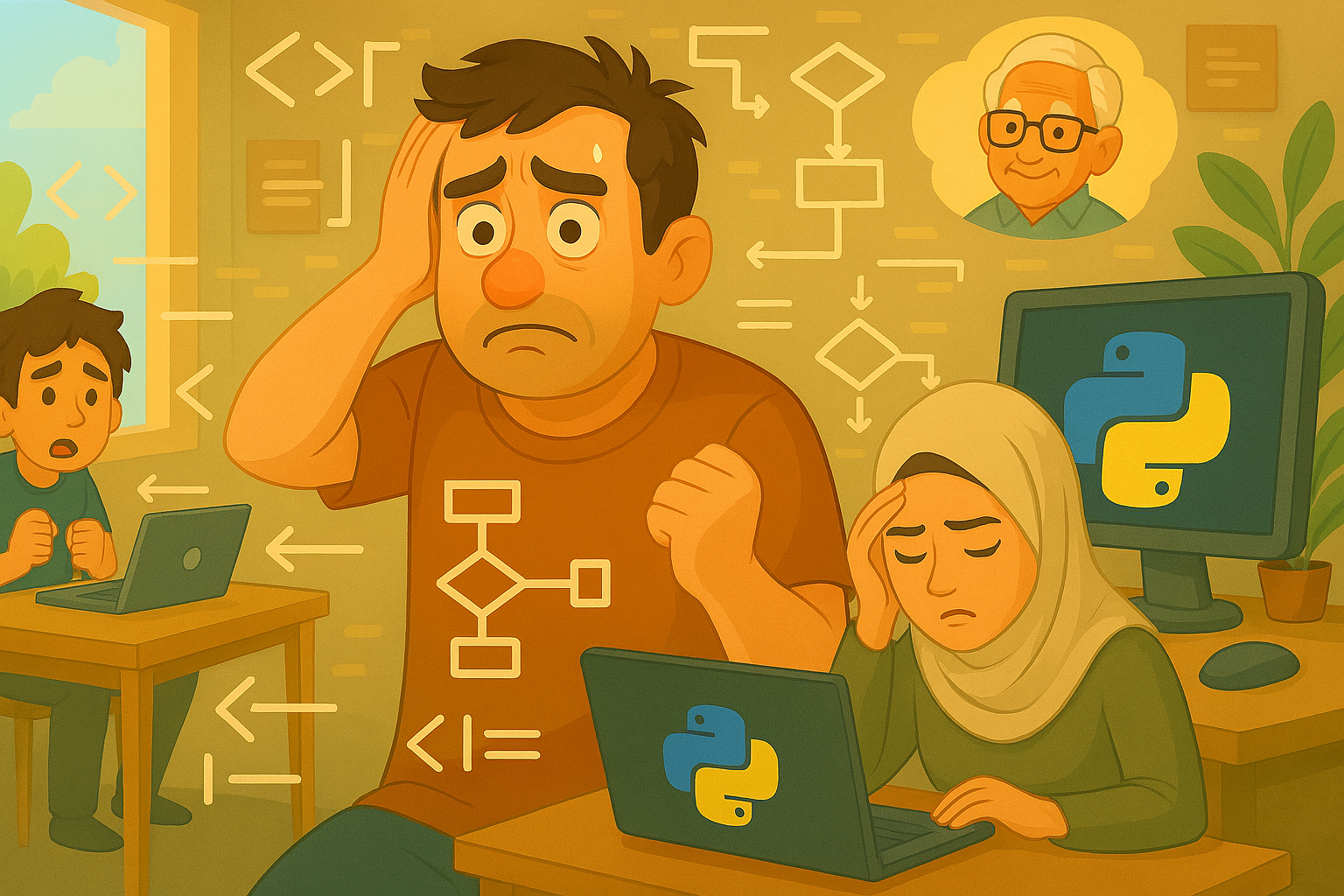
You are over 30, you know nothing about computers, and you think it is too late to learn coding. Or maybe you are still in your teens and feel this world is too complicated.
You probably think the programming world belongs only to teenage geniuses in Silicon Valley garages or IT graduates with fancy degrees. You feel left behind.
You are completely wrong.
I dove into a deep discussion on Quora involving dozens of senior Software Engineers, teachers, and IT practitioners. The question was simple.
Can someone learn Python at the age of 34 without computer knowledge?
Their consensus? It is highly possible, and the answer is a resounding YES.
Dave Wade Stein, a freelance coding instructor, even stated that he frequently teaches people much older than 34.
What truly determines your success in learning a programming language is not the number on your ID card. It is your motivation.
Let us break down why you are overthinking this and how you can start today.
Why Python? (The Secret IT Campuses Hide)
If you imagine a black screen with complicated green Matrix code like C or C++, forget about it.
Python was designed for normal humans.
This language is incredibly popular precisely because it is extremely easy to use and intuitive. Python is often the first language students learn because you are not required to immediately understand heavy concepts like computer architecture or memory management.
In fact, Python is extremely friendly for beginners because its syntax closely resembles the English language.
People with absolutely zero computer experience can start because Python is filled with simple English words like print, concat, and input.
Its simplicity is so extreme that many major universities are now dropping Java. They are replacing it with Python as the introductory language for new Computer Science students.
The Blueprint. A Roadmap to Becoming a Programmer from Zero
Are you convinced you can do it? Good. Now, let us talk strategy.
From the experiences of dozens of practitioners, wasting time watching random tutorials without direction is a fatal mistake. Here are the proven practical steps.
1. Buy a Physical Book and Do ALL the Exercises
Steve Baker, a Senior Software Engineer, suggests you buy a printed book. Something like “Learn Python in 24 hours” or similar.
The rule is brutal but effective.
MAKE SURE YOU DO ALL OF THE EXERCISES.
If there is a chapter you do not understand, never move on to the next one. Other books highly recommended by practitioners are Learn Python the Hard Way or Think Python.
2. Build Something Meaningful to You
Do not just memorize code.
Ryan Gagné suggests learning through small projects that you can finish, and that mean something to you.
- Write scripts.
- Automate the boring and repetitive computer tasks in your current job.
3. No PC? Not an Excuse!
Do you need an expensive laptop? No.
Khaliq Ansari mentioned that you can even learn Python programming without a computer by simply relying on a smartphone and an online compiler. You can also utilize apps like Pydroid 3 or the Mimo coding app.
In fact, not having a computer can be a hidden advantage. Imagine this. You do not need a stiff desk or a hardware setup that takes up time. You can execute lines of code while relaxing on your bed. You can practice algorithms while waiting in line at the grocery store. You can complete a course module while waiting for the bus to campus.
Fact is, you are not alone in this. More than 10 million people have downloaded and relied on Pydroid 3 and Mimo to turn their smartphones into powerful and portable learning machines.
4. Utilize YouTube and Online Course Platforms
Learning through YouTube, video tutorials, or even structured classes like Coursera and Udemy provides insights that are also among the best. It all comes back to your preferred learning style. Practitioners suggest finding structured tutorial playlists on YouTube. You can also take a comprehensive course on Udemy like the 100 Days of Code The Complete Python Pro Bootcamp by Dr. Angela Yu.
If visual and audio elements help you understand better, this is the perfect route.
5. Make AI Your Ultimate Learning Cheat Code
In today’s era of AI dominance, one way learning might feel stiff and boring. This applies whether you are learning purely from textbooks, Google scripts, Mobile app practice materials, YouTube tutorials, or online course syllabuses.
The solution is simple.
Integrate all those knowledge sources with your favorite AI intelligence like ChatGPT, Claude, or Gemini. Turn that chatbot into an interactive mentor, a coding game arena, a custom challenge creator, or a deep discussion partner to break through any material you are stuck on.
The ultimate advantage? AI is ready to be your loyal partner around the clock, regardless of whether you are typing on a powerful laptop or just using a smartphone screen.
This advice is even echoed by IT practitioner Kivi Lansimaki. He recommends using AI to explain Python documentation and code examples. Your material sources provide a structured curriculum, while AI gives you interactivity.
You are no longer learning alone.
However, if you want to truly utilize AI as a limitless learning partner, you must overhaul how you view it. For the complete guide, you absolutely must read my article: Stop Treating AI Like a Search Engine. Generative AI Changed Mental Health Forever.
But be careful. There is one deadly trap. AI can hallucinate. It can give you lines of Python code that look perfect and convincing even when they are completely wrong. To ensure you do not get lost by AI lies during your learning process, equip yourself with the insights in this article: Here’s Proof That Your “Smart” AI Model Is Actually Delusional.
The Bitter Reality You Must Accept
As someone who works deeply in the tech world, I can tell you a secret. Mastering Python syntax is easy, but that alone does not make you a Software Engineer.
Phil Teplitzky, a Managing Director, gives a stern warning.
Just learning the syntax of a language is an absolute waste of time.
The real question is not whether you can learn Python. The real question is whether you can learn all the things needed to use it effectively.
To truly become an expert, you eventually must learn deeper computer science concepts like algorithms and data structures.
Additionally, IT practitioner Sai Babu B notes one side effect of Python. This language has too many built in functions that spoil you. As a result, if you later have to learn a more rigid language like C or Java, the transition might feel a bit challenging.
However,
do not let this fact stop you.
This is exactly why Python is so brilliant for beginners. You do not learn to drive using a Formula 1 racing car, do you? Python acts as a very friendly starting ladder. It builds your logic, problem solving skills, and confidence without frustrating you in the first week.
Once you are proficient and accustomed to thinking like a programmer through Python, conquering more advanced algorithmic concepts or switching to a harder programming language later on
is simply a matter of minor adaptation.
The Takeaway
Age is just a number.
You only need basic English understanding, a little math ability, and strong willpower.
Do not let your current age be an excuse not to catch up with technology. As Chris Chovanek, a 50 year old IT practitioner who is still learning, said.
“It’s only too late when your dead.”
For those of you starting for the first time today, time is too valuable an asset. Do not waste time dealing with complicated program installations on your computer.
You must immediately focus on sharpening your logic instead of arguing with an operating system.
Before you execute the steps above, you absolutely must read my shortcut guide: Stop Installing Python on Your Laptop. Google Colab Changed How We Code Forever.
That article will show you the most modern way to start writing code directly from your browser without the hassle and without installation.
Save your energy for the most important thing. Transforming yourself into a true programmer.
Did this article open your eyes to start coding? Leave a clap 👏, share it with friends who feel too old or young, and
let me know in the comments!
Do not forget to hit Follow so you do not miss my other tech insights. Happy Pythoning!
